The Lean Assets Control Loop: From Chaos to Control in 4 Steps
2026 January 03
You did it. You spent a month building the “perfect” asset spreadsheet. Every laptop, license, and scanner is accounted for. It’s a masterpiece of VLOOKUPs and conditional formatting.
Three months later, it’s useless.
Three new hires, five departures, a lost tablet, and two software renewals have turned your masterpiece into a relic. The chaos is back.
The problem wasn't your spreadsheet. The problem was your approach. You treated asset management like a one-time project. It’s not. It’s a continuous process.
The Project Trap: Why One-Time Cleanups Fail
Almost every company starts by trying to solve asset chaos with a project:
- The Big Inventory: Someone is tasked with finding everything and putting it in a list.
- The Tool Purchase: You buy an asset management tool, import the list, and declare victory.
- The Slow Decay: Without a process to govern it, the data gets stale. People stop updating it. Within a quarter, you’re back to guessing.
A project has an end date, asset governance doesn't. People join, people leave, and equipment moves every single day. You don't need a project, you need a system.
The Lean Assets Control Loop
Instead of a linear project, we use a continuous four-stage loop. Each stage feeds the next, creating a system of permanent control that adapts as your business changes.
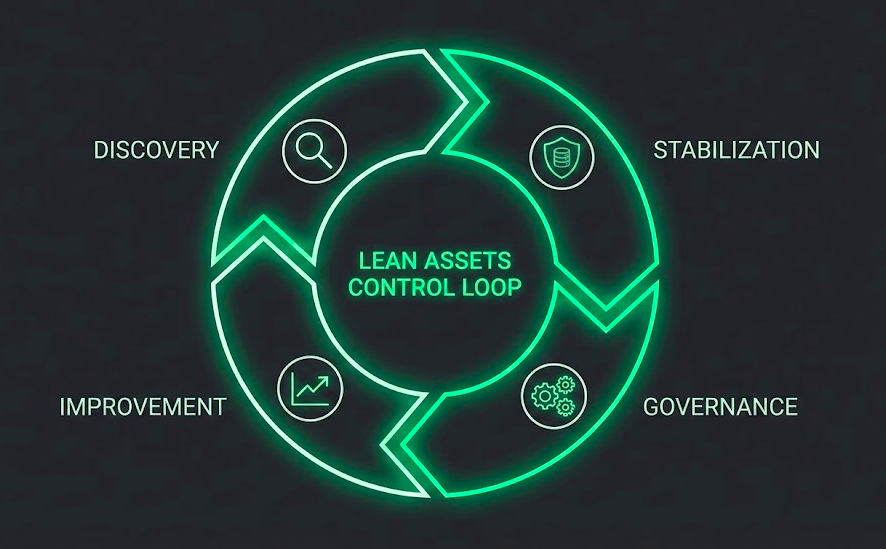
Step 1: Discovery (“See the Damage”)
Before you can fix the problem, you have to measure it. The Discovery phase isn't just about cataloging assets, it’s about uncovering risk and quantifying financial exposure.
What we do:
- Combine existing inventories, spreadsheets, invoices, and HR lists.
- Catalog both IT assets (laptops, licenses) and Operational assets (vehicles, tools, scanners).
- Don't just list assets; we identify ownership gaps, "ghost assets" (in the system but physically missing), and security risks.
The output isn't a list. It's a quantified exposure report that answers: "How much is asset chaos costing us per year?" This is the business case for fixing the problem.
See these gaps in your own business.
Our free 50-minute diagnostic will show you exactly where value is leaking from your asset lifecycle.
Schedule a Free DiagnosticStep 2: Stabilization (“Establish the Truth”)
With the damage quantified, Stabilization is a 60 days sprint to establish a single source of truth. This is where we bridge the gap from chaos to order.
What we do:
- Migrate all the fragmented data into a unified system of record.
- Clean the data, assign clear ownership for every single asset, and close the most critical initial gaps.
- Define the lightweight, practical rules for how assets will be managed going forward.
The output is a clean, reliable asset register. For the first time, you have a trustworthy foundation.
Step 3: Ongoing Governance (“Maintain Control”)
This is the engine of the loop. It’s the daily, weekly, and monthly work that prevents the system from decaying. This is where most internal efforts fail, they stop here. For us, this is the core of the service.
What we do (remotely):
- Lifecycle Management: Professionally coordinate every onboarding and offboarding to ensure assets are correctly assigned and recovered.
- Remote Verification: Use automated emails to have employees and managers confirm they have their assigned assets, creating a continuous audit trail.
- Exception Handling: When an asset is lost, broken, or unreturned, we manage the investigation and document the resolution.
The output is discipline. The system stays clean because it is actively governed. We ensure that when employees leave, everything comes back, or we tell you exactly why it didn't.
Step 4: Continuous Improvement (“Adapt and Refine”)
A static system is a dying system. Your business evolves, you enter new markets, add new types of equipment, and change team structures. The governance process must adapt.
What we do:
- Analyze trends from the Governance phase (e.g., "We lose 15% of all new scanners within 90 days.").
- Provide executive-level reporting on risk, not just activity.
- Recommend and implement adjustments to the controls (e.g., "Let's change the scanner checkout process.").
The output is intelligence. The system gets smarter, your risks decrease, and asset governance becomes a strategic function, not a reactive chore.
It’s a Loop, Not a Line
The magic is in the cycle. An exception found during Governance (a lost device) provides data for Improvement (a new policy), which strengthens the entire system. It never ends, and that's precisely why it works.
Stop trying to "finish" your asset inventory. You'll never be done.
Instead, build the loop. That's how you move from chaos to control.
Stop bleeding money.
We'll spend 50 minutes showing you exactly where your asset governance is failing.
Schedule Your Free Diagnostic